CHOICE Is Changing the Conversation. Your Benefits Strategy Should Be Part of It.

CHOICE Arrangement (ICHRA) gives employers an alternative to another traditional group-plan renewal — with greater control over the employer benefits budget and more individual coverage choice for employees.

Lirvion brings the administration together in one nationwide platform — from employer setup and enrollment through premium-payment visibility, reconciliation, and ongoing administration.

Talk to an Expert

ICHRA. CHOICE Arrangement. What changed?

As of September 2026, CMS uses "CHOICE Arrangement" in current employer-facing materials and states that CHOICE Arrangements were previously known as Individual Coverage Health Reimbursement Arrangements, or ICHRAs.

For employers and brokers, the important point is not simply the terminology.

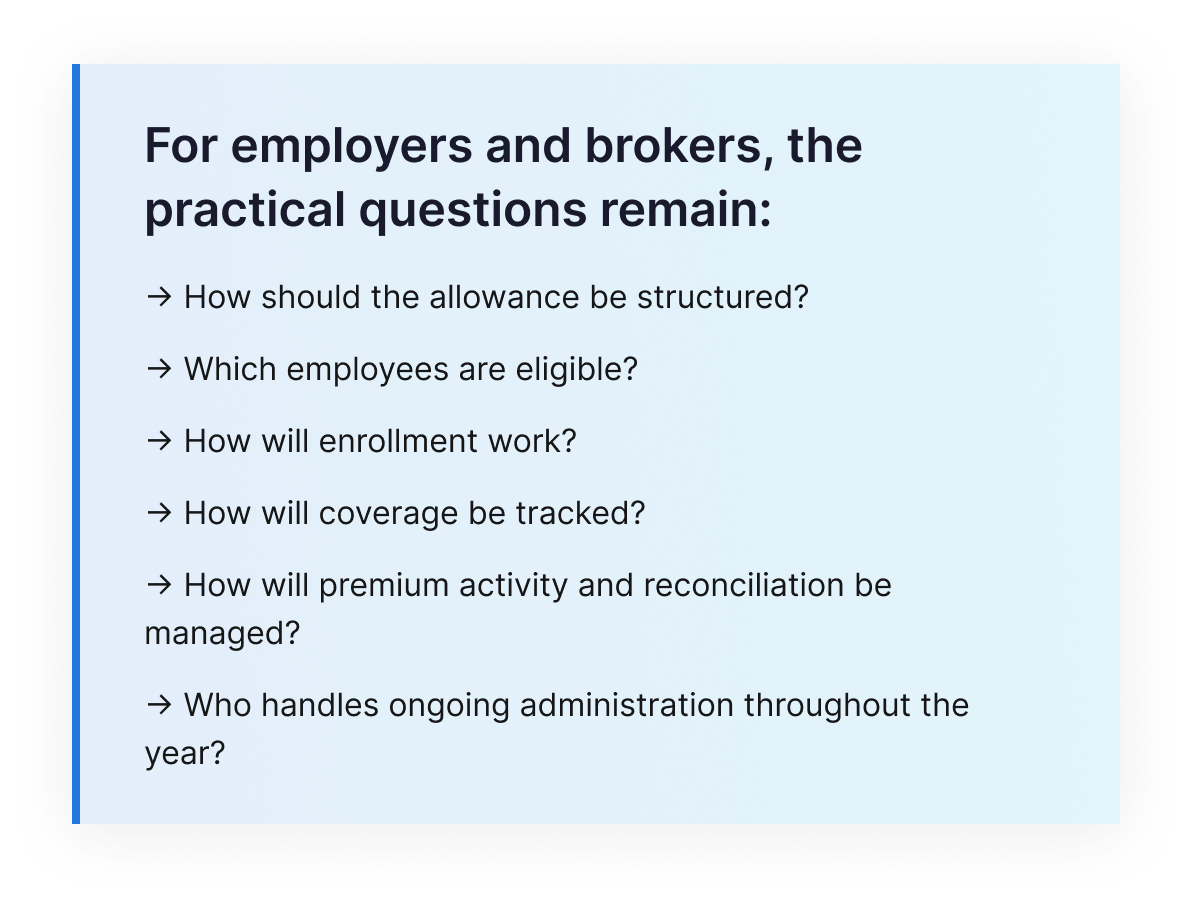
The real question is more practical:

Does the traditional group-plan model still make sense for this workforce — or is it time to evaluate a different approach?

Lirvion uses CHOICE Arrangement (ICHRA) when introducing the terminology and continues to use ICHRA throughout operational and product guidance where it remains the clearest established reference.

The bigger change isn't the name. It's the model.

Traditional group coverage generally asks an employer to select one or more plans for a workforce and then absorb the consequences of each renewal cycle. ICHRA takes a different approach. The employer defines an allowance structure within applicable rules. Eligible employees use that benefit toward qualifying individual health coverage available to them.

That shifts the conversation from:

Which group plan should we renew?

to:

How should we structure the employer benefit while giving employees more control over the coverage they choose?

The bigger change isn't the name. 
It's the model.

If every renewal starts with "How much is it going up this year?", the problem may be bigger than the renewal.

Annual renewal pressure often pushes employers into the same limited set of choices. ICHRA gives employers another strategy to evaluate.

The same limited choices

  • Accept the increase

  • Change carriers

  • Raise deductibles

  • Shift more cost to employees

  • Reduce benefits

ICHRA may be worth evaluating when you're dealing with:

  • Unpredictable group-plan renewals

  • Geographically distributed workforces

  • Employees with different coverage needs

  • Pressure to establish a more predictable benefits budget

  • Increasing administrative complexity

Before accepting another renewal, evaluate whether the model itself should change.

One employer. Multiple states. Different employee needs.

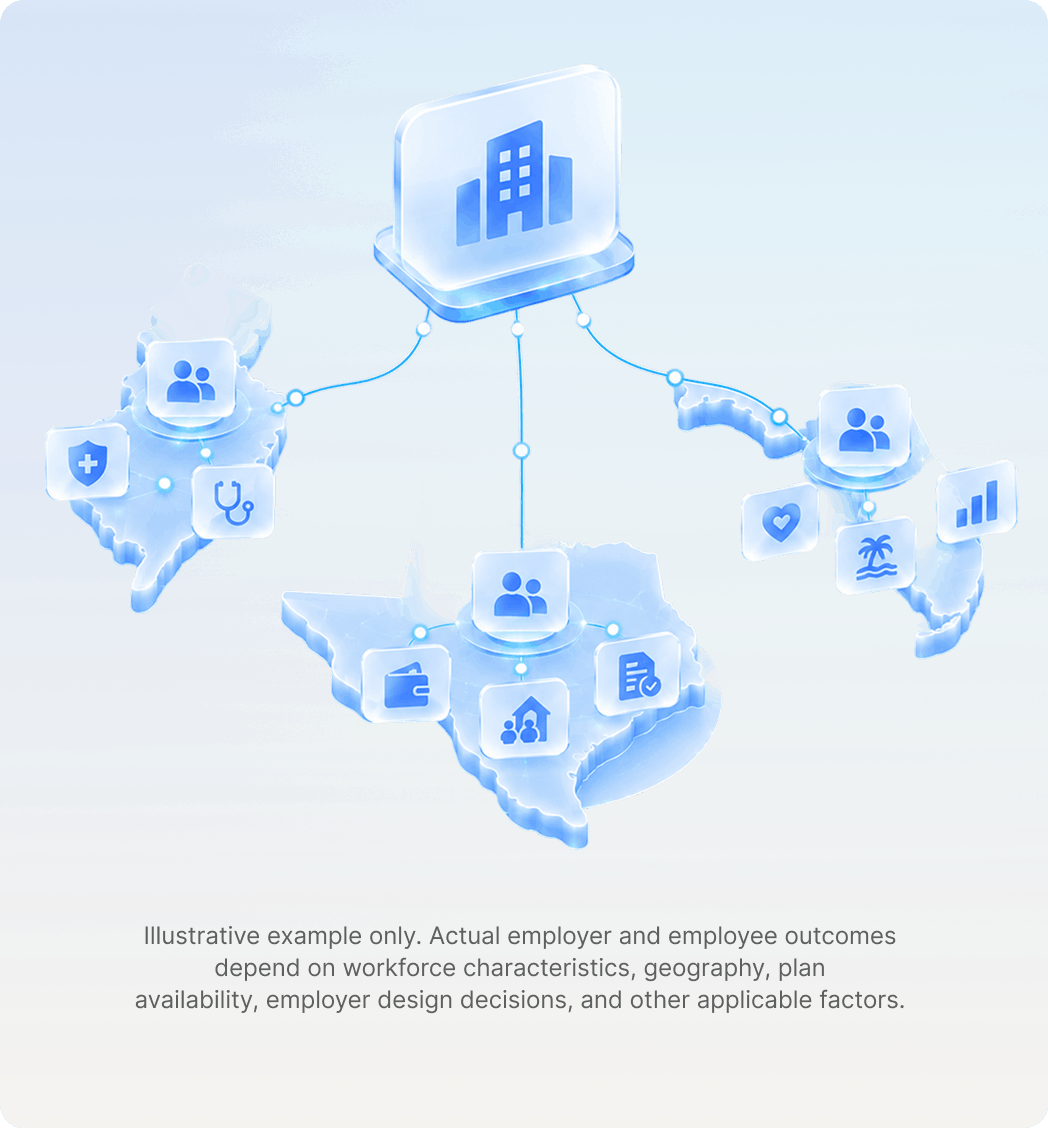
Consider an employer with 120 employees across New Jersey, Texas, and Florida. Those employees may face different individual markets, carrier options, provider networks, household needs, and premium levels. A benefits strategy designed around a geographically diverse workforce needs more than a single enrollment event. ICHRA allows the employer to establish the benefit structure while employees evaluate qualifying individual coverage available where they live. Lirvion provides the administration layer supporting those decisions throughout the plan year.

One employer strategy. Individual employee choice. Connected administration.

One employer. Multiple states. Different employee needs.

Nationwide benefits need nationwide administration.

A distributed workforce creates operational complexity long after the employer makes the decision to offer ICHRA.

Eligibility, employee classes, enrollment, coverage status, premium activity, employee changes, reconciliation, and ongoing administration all need to work together.

Lirvion is built to support ICHRA administration across the United States through one operational environment for employers, employees, brokers, and partners.

Because launching ICHRA is only the beginning. Running it well is what matters.

Nationwide benefits need nationwide administration.

More employee choice shouldn't create more employer chaos.

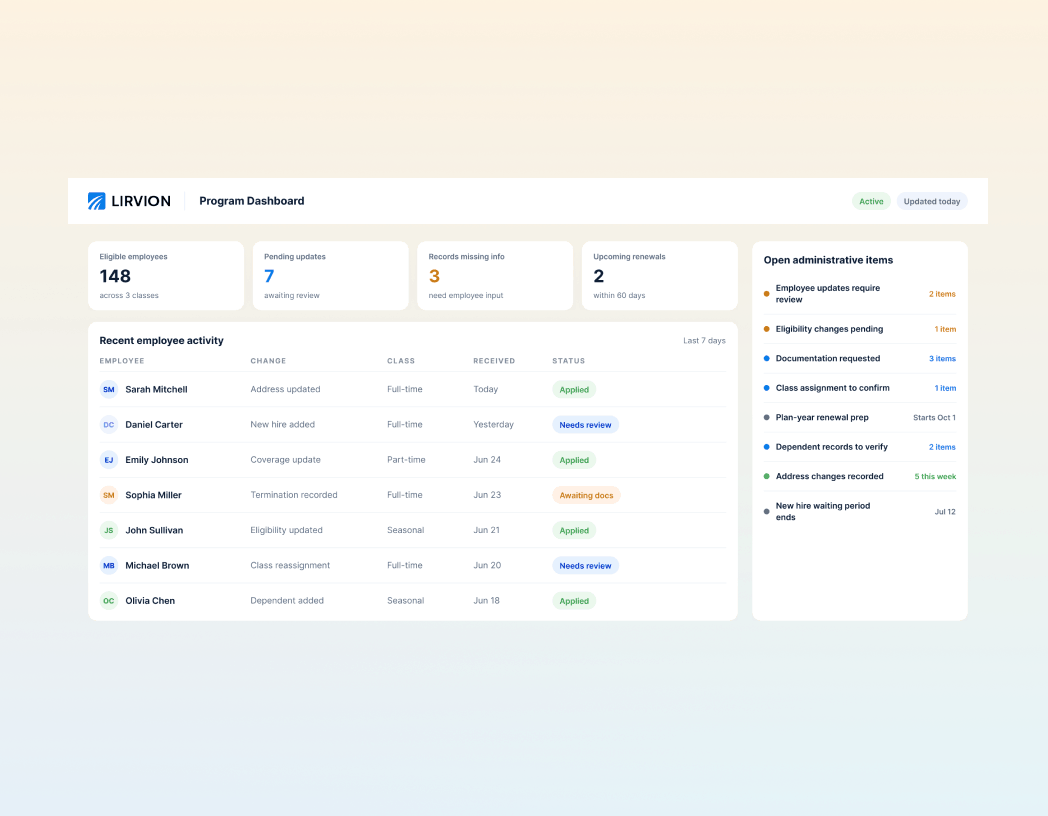
Changing the benefits model should not mean creating a fragmented administration process. Lirvion brings the operational pieces employers need into one administrative workflow:

Employer Setup

Manage eligibility, employee classes, allowances, and plan-year configuration.

Enrollment Support

Provide employees with supported paths to evaluate and enroll in qualifying individual health coverage.

Coverage Visibility

Track coverage status and documentation requirements.

Premium-Payment Visibility

Maintain visibility into premium-payment activity and allowance usage.

Monthly Reconciliation

Bring participation and payment information together for ongoing review.

Ongoing Administration

Manage changes, reporting, employee activity, and recurring administration after implementation.

Employer Setup

Manage eligibility, employee classes, allowances, and plan-year configuration.

Enrollment Support

Provide employees with supported paths to evaluate and enroll in qualifying individual health coverage.

Coverage Visibility

Track coverage status and documentation requirements.

Premium-Payment Visibility

Maintain visibility into premium-payment activity and allowance usage.

Monthly Reconciliation

Bring participation and payment information together for ongoing review.

Ongoing Administration

Manage changes, reporting, employee activity, and recurring administration after implementation.

Plan availability, pricing, provider networks, coverage details, and enrollment options may vary by location, carrier, household, and supported enrollment method.

For brokers: bring the strategy. Keep the relationship.

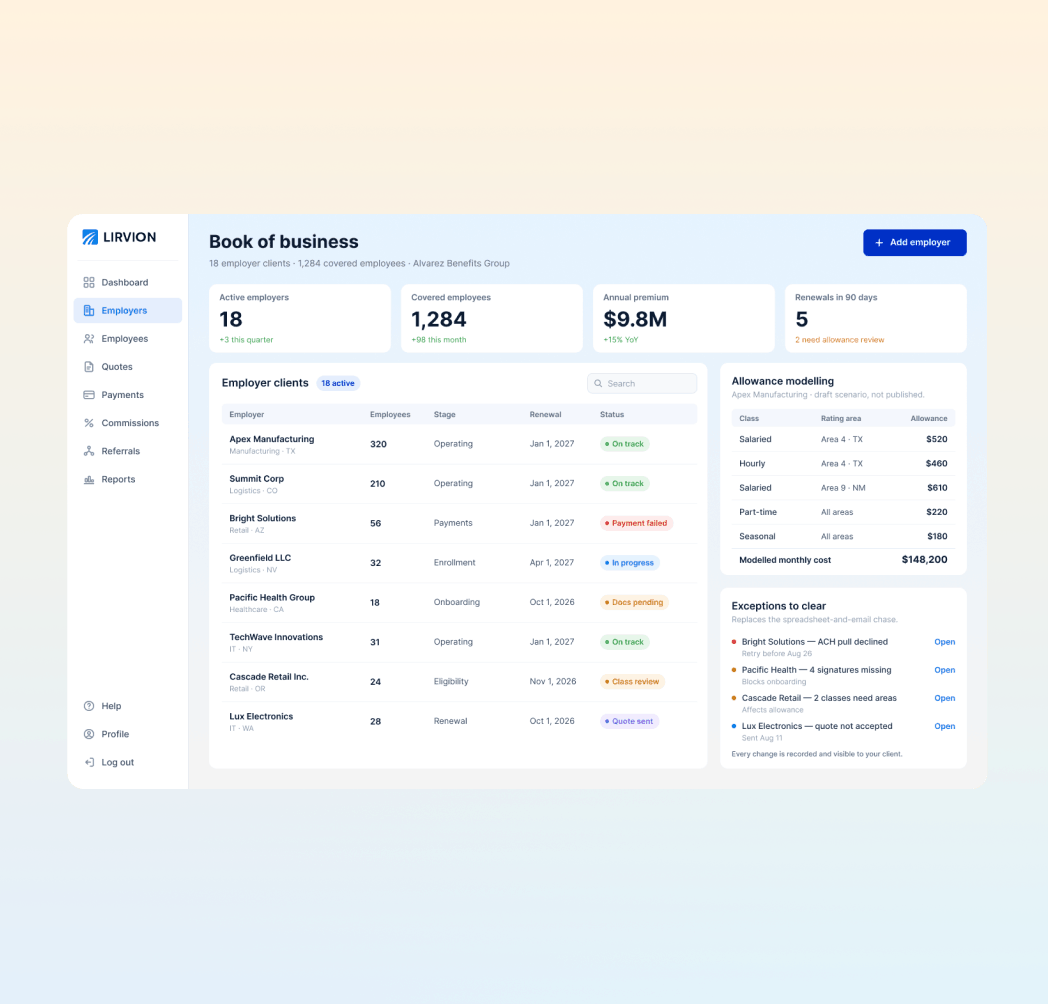
Your clients may already be asking about rising renewals, ICHRA, CHOICE Arrangement, or alternatives to traditional group coverage. You should not need to build the administrative infrastructure yourself to help them evaluate another strategy.

Lirvion supports benefits professionals through its Broker Program and Referral Program, depending on the relationship, employer, state, and applicable licensing requirements.

Stay at the center of the client conversation.

Lirvion runs the administration behind the strategy, so brokers can stay focused on advising the employer and managing the client relationship instead of building an ICHRA operating stack from scratch.

You bring the relationship. Lirvion brings the infrastructure for what comes next.

Explore the Broker Program
For brokers: bring the strategy. Keep the relationship.

For employers: control the strategy without choosing one plan for everyone.

Employers determine the benefit structure. Employees gain greater control over selecting qualifying individual coverage based on their location, household circumstances, coverage priorities, and available options. Lirvion manages the employer-side administrative workflow throughout the plan year.

Employer-defined benefits. More individual choice. Administration built to keep pace.

For employers: control the strategy without choosing one plan for everyone.

ICHRA Is not a DIY benefits strategy

EligibilityEmployee classesAllowancesEnrollmentCoverage documentationPremium paymentsReconciliationEmployee changesReportingOngoing administration

The concept is straightforward. The execution is not. For a growing or multi-state workforce, the pieces below are not isolated tasks — they are connected operating processes. Lirvion is built for the part that comes after "yes."

Is ICHRA right for every employer? No.

ICHRA is not automatically the right strategy for every organization. Several factors can affect whether the model makes sense:

Workforce geography

Employee classes

Affordability requirements

Individual-market conditions

Existing group coverage

Employer objectives

Administrative considerations

Workforce geography

Employee classes

Affordability requirements

Individual-market conditions

Existing group coverage

Employer objectives

Administrative considerations

That is why the first step should not be assuming ICHRA is the answer. It should be evaluating whether it is a better answer for this particular employer.

What does CHOICE Arrangement mean?

As of September 2026, CMS describes CHOICE Arrangements within the health reimbursement arrangement framework and uses the term for employer-sponsored arrangements through which eligible employees can use an employer-funded amount toward qualifying individual health coverage. Lirvion refers to that employer-funded benefit as an allowance throughout its product and educational materials.

Those are the questions Lirvion is built to help administer.

What does CHOICE Arrangement mean?

Before You Renew the Group Plan, Compare the Alternative.

If traditional group coverage is becoming harder to predict, harder to manage, or harder to justify, another renewal does not have to be the automatic answer.

See how CHOICE Arrangement (ICHRA) could work for your workforce, your benefits budget, and your next plan year.


Start with your workforce and the benefits problem you are trying to solve — not a generic pitch.